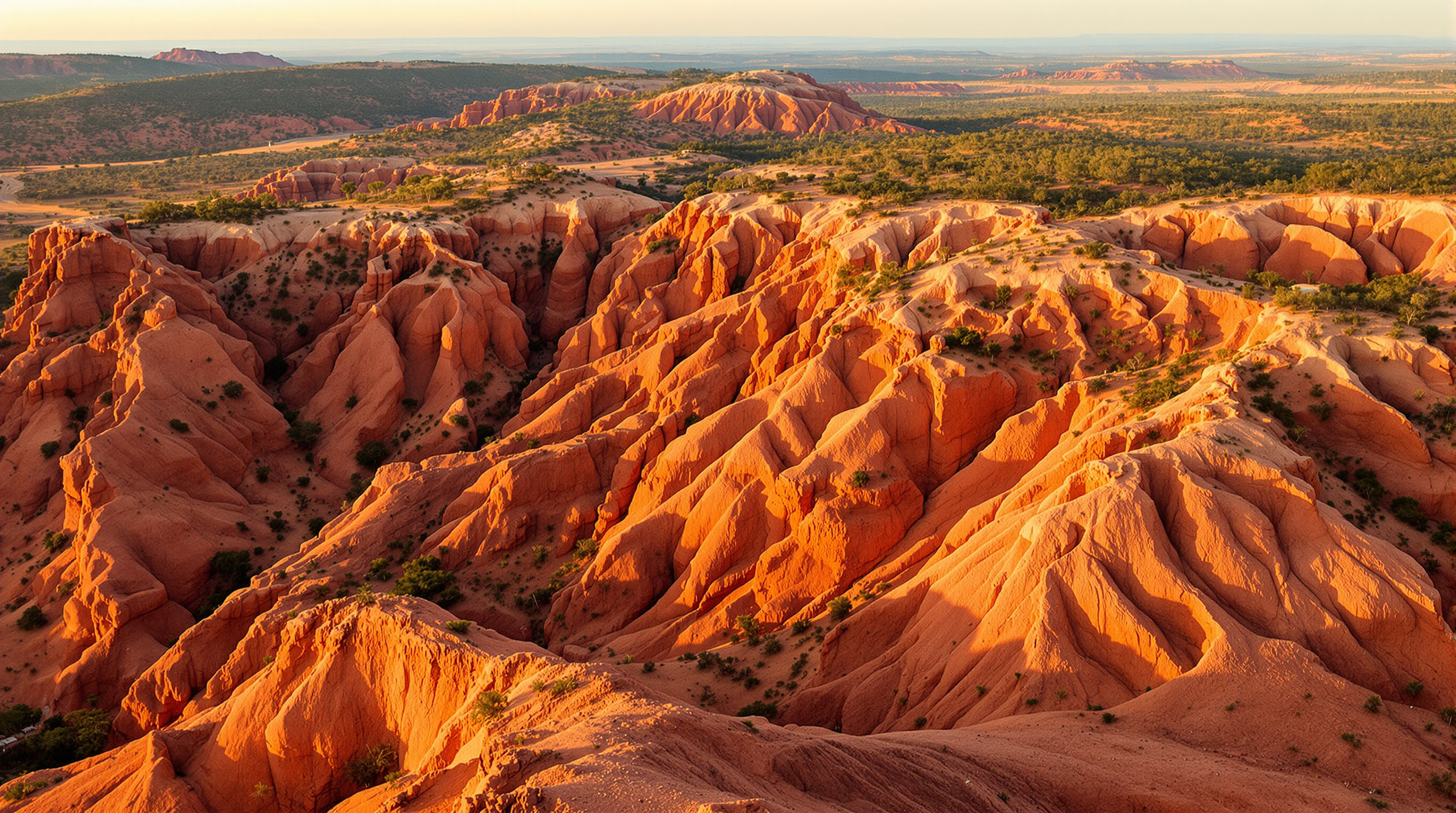
Serra da Capivara National Park in the state of Piauí, northeastern Brazil, is one of the most important rock art sites in the world. A UNESCO World Heritage Site since 1991, the park preserves over 800 documented archaeological sites within 130,000 hectares of caatinga scrubland — an unparalleled concentration of prehistoric human activity spanning tens of thousands of years.
Park Overview
The park was established in 1979 to protect the extraordinary concentration of archaeological sites discovered during surveys led by archaeologist Niède Guidon beginning in the 1970s. Its recognition as a UNESCO World Heritage Site in 1991 acknowledged what researchers had already determined: that the painted sandstone shelters, stratified deposits, and fossil fauna of Serra da Capivara collectively constitute one of the most significant archives of early human presence in the Americas.
The park occupies a dramatic landscape of mesa-like sandstone plateaus — the chapadas — cut by deep canyons and ravines. The erosion of this plateau over millions of years created thousands of natural shelters in the canyon walls, many of which were used repeatedly by prehistoric populations for habitation, ritual, and image-making. The semi-arid caatinga vegetation, adapted to the region's harsh climate of intense dry seasons and episodic rainfall, supports a distinctive fauna including peccaries, armadillos, maned wolves, and a rich community of birds and reptiles.
The Rock Art
The park's rock art belongs primarily to the Nordeste Tradition — Brazil's great prehistoric painting tradition characterized by vivid red and yellow ochre scenes of human activity, hunting, ceremony, and cosmology. The corpus at Serra da Capivara is staggering in scale: tens of thousands of individual painted figures distributed across hundreds of shelters, ranging from single isolated images to complex multi-panel compositions covering hundreds of square meters of sandstone wall.
The paintings depict hunting scenes of extraordinary dynamism — figures pursuing deer through stylized landscapes, working in coordinated teams with decoys and beaters — alongside scenes of apparent ritual gathering, sexual activity, fighting, and what appear to be cosmological or mythological narratives involving large hybrid beings. Animal subjects include deer, armadillos, tortoises, fish, snakes, and a variety of birds, all rendered with the lively, shorthand precision characteristic of the Nordeste tradition at its finest.
The most celebrated single site within the park is Boqueirão da Pedra Furada — a dramatic natural arch in the canyon wall beneath which excavations have produced radiocarbon dates stretching back tens of thousands of years, along with stratified deposits containing charcoal, stone tools, and the remnants of hearths. The painted walls of Pedra Furada are among the most visited in the park, with figures superimposed across multiple apparent episodes of painting spanning thousands of years.
The Pedra Furada Controversy
Serra da Capivara occupies a central position in one of the most contentious debates in New World archaeology: the question of when humans first arrived in the Americas. Niède Guidon and colleagues at FUMDHAM have published radiocarbon dates from Pedra Furada as early as 48,000–60,000 years before present — dates that, if valid, would push human presence in the Americas back by more than 30,000 years beyond the currently accepted mainstream consensus of approximately 15,000–16,000 BP.
Skeptics, including prominent North American and European archaeologists who visited the site in the 1990s, argued that the dated charcoal derives from natural brush fires rather than human hearths, and that the supposed stone tools are geofacts — stones fractured by natural processes, not human knapping. Guidon and her supporters have disputed these interpretations vigorously, pointing to the spatial association of dated materials with what they identify as unambiguous cultural features.
The debate has not been definitively resolved. More recent analyses using optically stimulated luminescence (OSL) and other non-radiocarbon methods have added further complexity without producing consensus. For visitors and students, the controversy is itself part of what makes Serra da Capivara intellectually compelling — it sits at the frontier of what we know and don't know about the deep human past.
What would actually settle it is worth spelling out, because it explains why the dispute has proved so durable. The disagreement is not really about the radiocarbon measurements themselves, which few contest; it is about what the dated carbon was and how it came to sit where it was found. Resolving that requires evidence of a different kind: unambiguous cultural features in undisturbed stratigraphy, lithic assemblages whose fracture patterns can be distinguished statistically from gravity-fractured quartzite cobbles falling from the cliff above, and — critically — excavation and analysis carried out by teams with no prior commitment to either position. Several of those conditions have been partially met over the past three decades, which is why the early dates are neither accepted nor dismissed outright. It is a textbook case of a claim whose weight depends less on any single measurement than on the documented provenance of the sampled material, a theme explored further in our discussion of research methods and standards of evidence.
Visiting Serra da Capivara
Gateway town: The nearest town is São Raimundo Nonato, approximately 30 km from the park entrance. São Raimundo Nonato is a small but growing town with several hotels, restaurants, and tour operators catering to visitors. The town is also home to the Museu do Homem Americano (Museum of the American Man), FUMDHAM's flagship institution, which houses an extraordinary collection of fossil fauna, archaeological artifacts, and reproductions of the park's rock art.
Getting there: São Raimundo Nonato is approximately 530 km from Teresina (Piauí's state capital) by road, or roughly 300 km from Petrolina in Pernambuco. The nearest commercial airport is in Petrolina (PNZ), served by domestic flights from São Paulo and Recife. From Petrolina, the drive to São Raimundo Nonato takes approximately four hours via the BR-235 and BR-020 highways.
Best season: The dry season (May through October) is far preferable for visiting — trails are accessible, and the dramatically eroded sandstone landscape is at its most photogenic. The wet season (November through April) brings heavy rains that make canyon trails treacherous and can close sections of the park entirely.
Guided tours: All visits within the archaeological zones require a licensed guide, available through FUMDHAM and through tour operators in São Raimundo Nonato. This is both a legal requirement and a practical necessity — the park is large, signage is minimal, and many of the most significant sites are not on the main visitor circuits.
Conservation Challenges
Despite its UNESCO protection, Serra da Capivara faces significant conservation pressures. Funding for park management and site maintenance has been inconsistent, reflecting broader challenges in Brazilian conservation funding. Biological colonization — particularly the growth of lichens, algae, and wasp nests directly on painted surfaces — remains a chronic management challenge. Climate change is altering the caatinga ecosystem in ways that affect the microenvironmental stability that has preserved pigments for millennia.
FUMDHAM has pioneered conservation techniques adapted to the specific conditions of sandstone-shelter rock art in semi-arid environments, and the organization's work provides a model for similar challenges across the Nordeste tradition region. Read more about rock art conservation approaches and challenges.