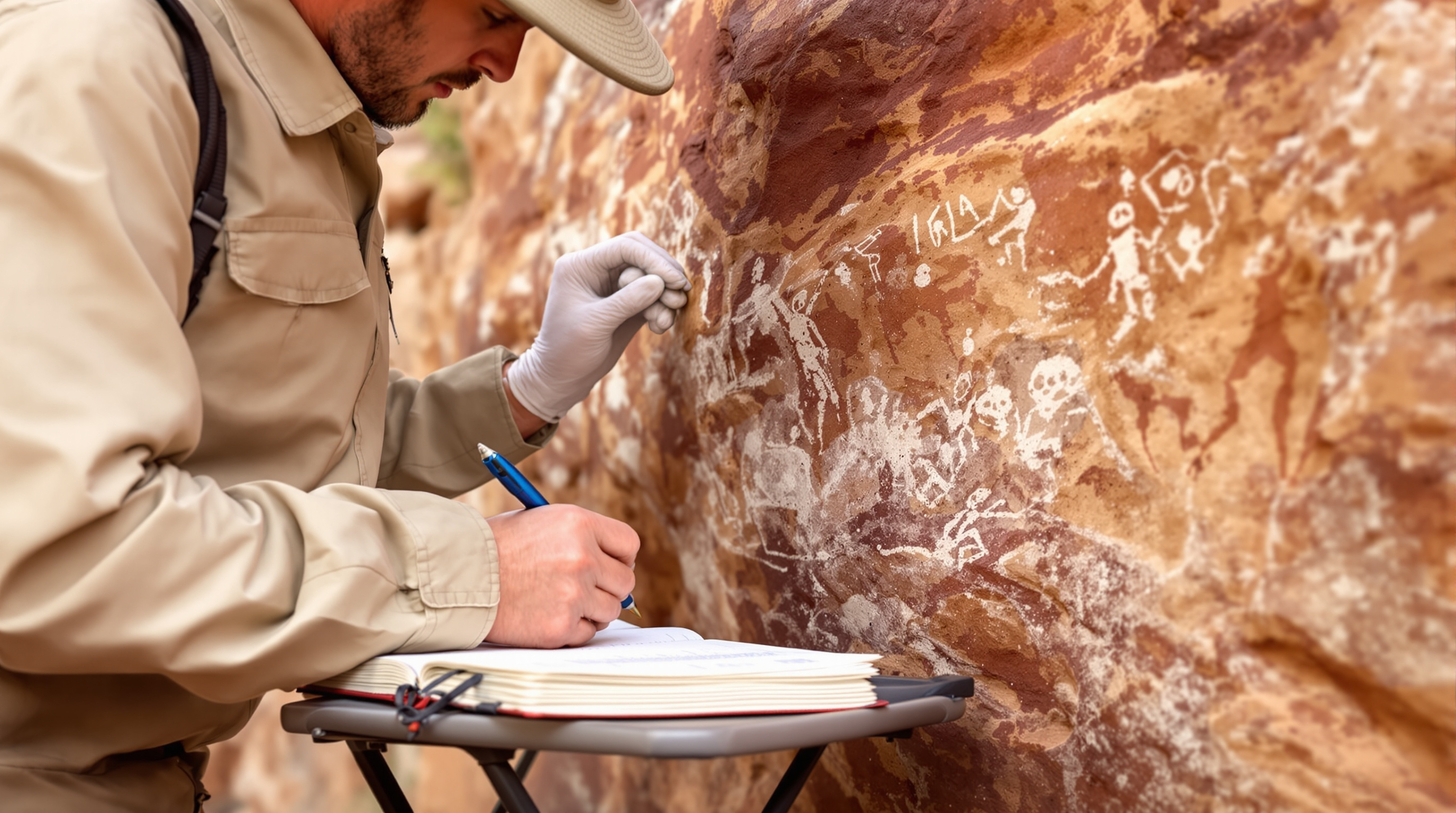
Rock art is among the most fragile categories of cultural heritage. Unlike portable artifacts that can be stabilized in controlled museum environments, prehistoric paintings and petroglyphs are permanently embedded in living landscapes exposed to weathering, biological colonization, human pressure, and a changing climate. Protecting them requires an integrated understanding of geology, ecology, heritage law, and community engagement.
The Fragility of Rock Art
It is worth pausing to appreciate how remarkable it is that any painted rock art survives at all. Pigments applied to open rock surfaces or cave walls are exposed to the full range of environmental stressors that erode stone over geological time — yet some images have persisted for ten thousand years or more. Their survival is not accidental: it reflects specific combinations of pigment chemistry, substrate geology, shelter geometry, and microclimate that together create preservation niches within which organic and mineral paint layers can remain stable over millennia.
Understanding why some sites preserve well and others deteriorate rapidly is a core question in conservation science, and the answers have practical implications for management — identifying which sites are inherently vulnerable and which can sustain greater visitor pressure, and prioritizing interventions where deterioration is active.
Natural Threats
Weathering and Thermal Cycling
Rock surfaces expand and contract with temperature changes, and the differential thermal behavior of paint layers versus substrate creates shear stresses that progressively delaminate pigment from the rock face. In semi-arid environments like the caatinga of northeastern Brazil — where daytime temperatures can exceed 40°C and nights are significantly cooler — thermal cycling is one of the most persistent natural deterioration agents. Freeze-thaw cycling in temperate and alpine rock art regions produces similar effects through hydraulic expansion of water in rock pore spaces.
Biological Colonization
Lichens, algae, cyanobacteria, mosses, and higher plants colonize rock surfaces with varying degrees of damage to underlying imagery. Lichens are particularly problematic: they penetrate rock surfaces mechanically through hyphal growth and produce organic acids that dissolve mineral substrates and attack mineral-based pigments. Algal mats trap moisture against the rock face, creating conditions favorable for further biological and chemical deterioration. Wasp nests, common in Brazilian rock shelters, damage paintings both through the direct mechanical pressure of nest attachment and through the moisture and chemical compounds they introduce.
Hydrology and Moisture
Water moving through, over, and across rock surfaces is one of the primary agents of rock art deterioration globally. Direct rain splash on open panels, runoff channeled across painted surfaces, groundwater seeping through rock fractures, and rising damp from soil contact all introduce moisture that promotes salt crystallization, biological colonization, and physical erosion. Shelter geometry — the shape of the overhang protecting a painted wall — is often the most important single factor determining a painted panel's long-term survival prospects.
Structural Failure and Spalling
Rock shelters are dynamic geological structures. The same erosional processes that created shelters in the first place — undercutting of soft sandstone beneath resistant caprock — continue after paintings are made. Ceiling collapses and wall spalling can destroy painted surfaces in seconds. These events are inherently unpredictable and essentially impossible to prevent, though structural monitoring can sometimes identify zones of active instability where intervention (reinforcement, evacuation of vulnerable areas) may be warranted.
Human Threats
Vandalism and Inappropriate Contact
Direct human damage to rock art takes many forms, from casual graffiti to deliberate destruction. Among the most damaging visitor behaviors is chalking — the application of chalk or chalk-like substances to painted or engraved surfaces to enhance their visibility for photography. This practice, once common even among researchers, introduces foreign chemical compounds that accelerate deterioration and is now universally condemned. Equally damaging is direct touching: even clean hands transfer oils, salts, and microorganisms that accelerate deterioration. At heavily visited sites, the cumulative effect of thousands of visitor contacts can visibly degrade painted panels within years.
Inappropriate Access
Unmanaged access to sensitive sites — whether by casual visitors, photographers, or researchers themselves — creates a range of physical impacts beyond direct contact. Dust raised by foot traffic deposits on painted surfaces; vegetation damage from informal trails alters site hydrology; the introduction of new biological communities through footwear can accelerate colonization of previously sterile surfaces.
Agriculture and Development
Agricultural expansion, road construction, quarrying, and reservoir creation have destroyed rock art sites across the Americas at a rate that dwarfs all other causes of loss combined. The dramatic losses to reservoir inundation in Brazil — where hydroelectric dam construction in the 1980s and 1990s destroyed or permanently submerged rock art sites in Minas Gerais, Goiás, and other states — represent an irreversible cultural catastrophe that galvanized the Brazilian rock art conservation community and contributed to the legal frameworks now in place to require archaeological survey before major development projects.
Conservation Approaches
The International Council on Monuments and Sites (ICOMOS) has established guidelines for rock art conservation that emphasize a hierarchy of approaches, from passive monitoring through active intervention. Key strategies include:
Monitoring: Systematic photographic monitoring — comparing standardized photographs taken at regular intervals from fixed camera positions — provides the most sensitive early warning of active deterioration and establishes baselines against which future change can be measured. Modern monitoring programs increasingly incorporate automated sensor arrays measuring temperature, humidity, light, and vibration at site-specific locations.
Biocide treatment: Where biological colonization threatens painted surfaces, carefully applied biocides — chemical agents that kill lichens, algae, and other colonizing organisms — can arrest active deterioration. Treatment protocols must balance the effectiveness of biocidal compounds against their potential to introduce foreign chemicals that may themselves damage pigments or substrate, and must account for the risk of rapid recolonization following treatment.
Structural stabilization: In cases of identified structural instability, engineered interventions — from targeted grouting of fractures to the installation of discrete stainless-steel supports — can extend the life of vulnerable sections of painted wall. These interventions require close collaboration between heritage conservators and geotechnical engineers and should be approached with a strong preference for reversibility.
Visitor management: Controlling visitor access is often the most cost-effective conservation measure available, and in many cases the most urgently needed. Strategies range from physical barriers (boardwalks, viewing platforms, fencing) that redirect visitor movement away from sensitive surfaces, to zoning systems that restrict access to the most vulnerable sites while concentrating visitor activity at more robust locations, to guide-required access that ensures visitors receive interpretation alongside supervision.
Digital preservation: High-resolution 3D scanning, multispectral imaging, and photogrammetric documentation create records of rock art that survive even if the originals are lost. While digital surrogates cannot replace physical sites, they provide insurance against catastrophic loss and enable continuing scholarly access to sites too fragile for repeated researcher visits.
Condition Assessment and the Problem of Slow Change
Almost everything that destroys rock art does so slowly. Salt efflorescence, granular disaggregation, lichen thallus expansion, and the incremental widening of a fracture all operate on timescales that defeat casual observation — a conservator returning after two years will usually perceive no difference at all, right up until a flake detaches. This is why formal condition assessment matters more in rock art than in almost any other heritage discipline: without a quantified baseline, deterioration is invisible until it is irreversible.
Good practice now favours scoring each panel against a standard condition index — recording the extent of biological cover, surface loss, mineral crusts, moisture staining, and anthropogenic damage as bounded numeric values rather than descriptive prose — so that successive surveys can be compared statistically instead of impressionistically. Photogrammetric models add a second, independent measure: two models captured years apart can be differenced to millimetre precision, revealing material loss that no photograph would show. The discipline required is less technical than administrative, since the value of a baseline lies entirely in whether anyone repeats the measurement on schedule a decade later.
The Role of Local Communities
The most successful rock art conservation programs are those that engage local communities not merely as labor or as the objects of interpretation, but as genuine stakeholders with their own relationships to the heritage being protected. The Serra da Capivara model — in which FUMDHAM's work at the national park has been accompanied by sustained investment in local training, employment, and economic development — offers a template for how conservation can be structured to create aligned incentives between heritage protection and local livelihoods.
Where indigenous communities maintain living cultural relationships with rock art sites — as is the case with many sites in the American Southwest, Australia, and parts of South America — conservation practice increasingly proceeds in partnership with those communities, treating their knowledge, authority, and ongoing ceremonial access as integral to management rather than as complications to be accommodated.
For more on the research methods that underpin conservation practice, see our overview of rock art research and documentation methods.