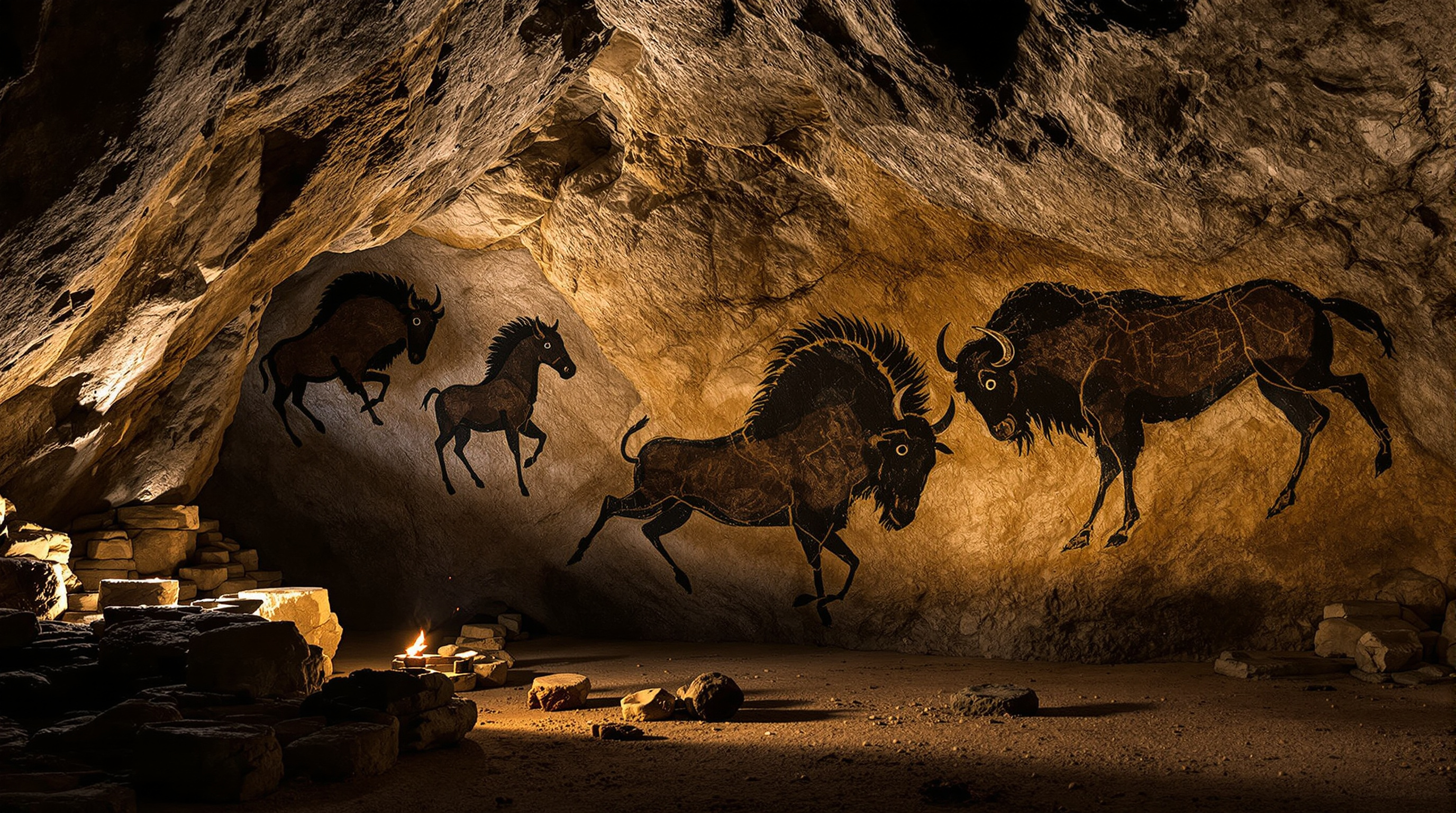
Art history as a discipline has historically begun with the ancient Near East or the classical world of Greece and Rome. But the visual record of humanity extends far deeper into the past, to the prehistoric images that appear on rock surfaces across every inhabited continent. Rock art is, in this sense, the oldest chapter of art history — and one that the discipline has only recently begun to integrate seriously into its canon.
The Origins of Symbolic Behavior
The question of when and why humans began making images is profound. The earliest evidence of symbolic behavior — ochre processing, perforated shell beads, geometric engravings — appears in African archaeological sites dating to at least 100,000 years ago. The earliest unambiguous representational imagery appears in sites in Sulawesi (Indonesia), with paintings dated to more than 45,000 years before present using uranium-series methods. Cave paintings in Europe, including the images of Chauvet Cave in France, date to approximately the same period.
What drove the emergence of image-making? Scholars have proposed many explanations: a cognitive revolution enabling abstract thought, the need to communicate across groups, the integration of image-making into ritual and ceremonial life, or the deep human drive to represent and make sense of the visible world. No single explanation commands universal agreement, and the evidence from different regions and time periods suggests that symbolic behavior may have emerged independently in multiple places.
Placing Rock Art in Art History
The challenge of integrating rock art into art history is partly disciplinary and partly methodological. Art history has traditionally focused on objects produced within complex literate societies where authorship, patronage, iconography, and reception can be reconstructed through documentary evidence. Rock art, by contrast, is anonymous, undocumented, often undatable with precision.
Yet the art-historical perspective offers something archaeological approaches sometimes miss: sensitivity to the formal qualities of images — composition, line, color, scale — and the capacity to compare imagery across traditions in ways that illuminate shared aesthetic concerns. Prehistoric and indigenous imagery has been drawn steadily further into art-historical scholarship, reflecting a gradual broadening of what counts as art history's subject matter.
Non-Western Art History and Rock Art
The study of rock art connects naturally to the art history of non-Western and indigenous traditions. Courses on Pre-Columbian art, African art, Oceanic art, and Native American art regularly engage with rock art as primary evidence. The integration of rock art also raises important questions about whose art gets counted as "art history" — questions with implications for how the discipline is taught, researched, and funded. Indigenous communities worldwide have advocated for approaches that take seriously the living cultural significance of rock art for descendant communities, rather than treating it purely as archaeological data.
This advocacy has begun to reshape the field. Rock art studies increasingly incorporate traditional ecological knowledge, oral traditions, and indigenous interpretive frameworks alongside scientific methods. The result is a richer, more pluralistic understanding of images that have been part of living cultures — not just the archaeological record.
Rock Art and Contemporary Art
Contemporary artists have long been drawn to rock art as a source of formal and conceptual inspiration. The bold geometric forms of Great Basin petroglyphs, the monumental painted figures of the American Southwest, and the intricate zoomorphic imagery of the Brazilian Nordeste have all influenced 20th and 21st century visual culture. This dialogue between contemporary practice and prehistoric imagery is an important part of rock art's ongoing cultural life, and a reminder that these ancient images continue to generate meaning and creative response millennia after their creation.
Reproduction, Enhancement, and the Ethics of the Image
Art history has always depended on reproductions, and rock art puts unusual pressure on that dependence. Almost nobody encounters these images directly; what circulates in books, lectures, and databases is a photograph, and increasingly a photograph that has been algorithmically enhanced to make faded pigment legible. Decorrelation stretching and multispectral compositing are genuine analytical tools, but they produce pictures that no human eye has ever seen at the site — colours are exaggerated by design, and a figure recovered from near-invisibility can end up looking more emphatic in reproduction than the original ever was on the wall.
The consequence is not trivial: judgements about line, composition, and the relative prominence of figures are formal judgements being made on processed surrogates. Careful publications caption the processing applied and print the unenhanced image alongside it, which should be the discipline's minimum standard.