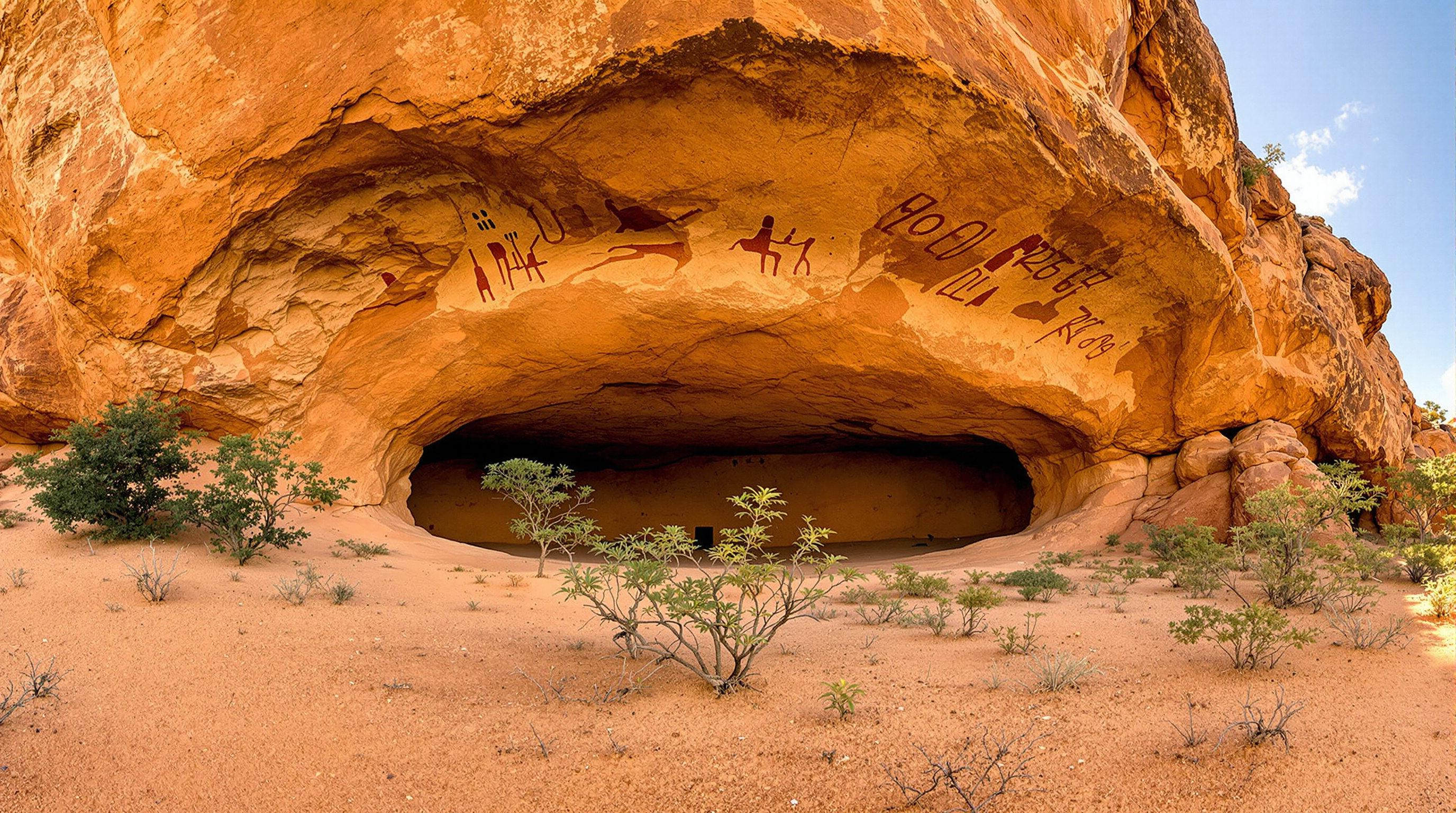
The Nordeste Tradition is the most extensively documented prehistoric rock art tradition in the Americas. Distributed across the semi-arid interior of northeastern Brazil, its thousands of painted shelters preserve a vivid visual record of human life, ceremony, and cosmology stretching back at least ten millennia.
What Is the Nordeste Tradition?
The term Nordeste Tradition was introduced by Brazilian archaeologists to describe a broadly coherent body of rock paintings found across the northeastern interior of the country. It is not a single homogeneous style but rather a family of related regional subtraditions that share certain fundamental characteristics — most importantly, an emphasis on the human figure and a preference for scenes of action and narrative over static symbolic imagery.
The tradition is defined by its painters' evident delight in depicting the world around them: people dancing, hunting, having sex, giving birth, fighting, and engaging in ritual. Animals — deer, armadillos, reptiles, birds — appear throughout, often in dynamic interaction with human figures. This narrative, scene-based quality distinguishes the Nordeste Tradition from many other major world rock art traditions, where symbolic or geometric imagery predominates.
Defining Characteristics
Several features mark Nordeste Tradition paintings across their geographic range:
- Pigments: Red and yellow ochres dominate, derived from iron-rich mineral deposits common throughout the region. White kaolin and charcoal black appear more rarely, often in later layers or as accent colors within larger compositions.
- Human figures in action: The signature element of the tradition is the active human form — rendered in silhouette or outline, typically small in scale (5–30 cm), and almost always in motion. Static frontal figures are the exception rather than the rule.
- Narrative scenes: Unlike many rock art traditions elsewhere, the Nordeste shows a strong tendency toward multi-figure compositions that read as scenes: hunts with beaters and quarry, ceremonial gatherings, apparent battles, and processions. These scenes sometimes extend across tens of meters of painted surface.
- Animals as co-protagonists: Zoomorphs in the Nordeste are not peripheral — they participate in the narrative. The deer (veado) is the most commonly depicted animal, followed by armadillos, fish, snakes, and a variety of birds.
- Superimposition: At prolific sites, paintings are layered across centuries or millennia of use, creating complex stratigraphy that researchers use to establish relative chronologies.
Geographic Distribution
The Nordeste Tradition's core territory covers the states of Piauí, Ceará, Rio Grande do Norte, Paraíba, Pernambuco, Alagoas, and Sergipe, with extensions into Bahia — particularly the Chapada Diamantina highlands — and the Seridó microregion straddling the Paraíba–Rio Grande do Norte border. The latter has become recognized as a distinct subregional variant, the Seridó Style, characterized by its own conventions for rendering human figures and a particular emphasis on geometric elements.
To the south and west, Nordeste-influenced paintings merge into and overlap with the Agreste Tradition and with the poorly understood rock art of Tocantins, Mato Grosso, and the upper Xingu basin. The boundaries between traditions in these frontier zones remain an active area of debate among Brazilian archaeologists.
Chronology: How Old Is the Nordeste Tradition?
The antiquity of the Nordeste Tradition is among the most contested questions in South American archaeology. The most dramatic claims — advanced most prominently by archaeologist Niède Guidon and her colleagues at FUMDHAM (Fundação Museu do Homem Americano) — propose occupation of the Pedra Furada rockshelter at Serra da Capivara as early as 50,000–60,000 years before present, based on radiocarbon dates from charcoal found in association with stone artifacts. If correct, this would push human presence in the Americas back by tens of thousands of years beyond the currently accepted consensus.
Most mainstream archaeologists remain skeptical of the extreme dates, arguing that the charcoal may derive from natural fires and the "artifacts" from geofacts — stones broken by non-human means. More conservative estimates place the earliest reliable occupation of the region at around 10,000–12,000 years before present, consistent with the broader picture of human dispersal through South America following entry via the Bering land bridge. The debate continues, and ongoing excavations at Serra da Capivara and other Piauí sites may eventually resolve it.
For the paintings themselves, direct radiocarbon dating has been applied to a small number of samples where organic material (charcoal-based pigments) was preserved in sufficient quantity. These dates cluster in the range of 6,000–10,000 BP for the earliest well-documented examples, though the tradition certainly continued to be practiced into the first millennium CE and possibly later in some areas.
It is worth being explicit about why direct dating remains so rare. Most Nordeste pigments are mineral — iron oxides ground and bound with an organic medium — and only the binder, not the ochre, contains datable carbon. Binders survive poorly in shelters that have cycled through ten thousand dry seasons, and the quantity required for accelerator mass spectrometry, though now measured in micrograms, still means removing paint from a figure. Conservators and dating specialists therefore weigh every sample request against permanent, unrecoverable loss, and most panels are simply never sampled. The chronology of the tradition consequently rests far more on stratigraphic association, superimposition sequences, and stylistic seriation than on absolute dates — a dependency worth remembering whenever a confident single number is quoted for the age of a painting.
Stylistic Diversity: The Angelim Style and Beyond
Within the broad Nordeste Tradition, researchers have identified numerous local and regional substyles. The Angelim Style, found in a restricted area of Ceará, is distinguished by its large-format anthropomorphs with elaborate headdresses and body ornamentation — figures that appear to represent costumed ritual specialists or mythological beings rather than ordinary humans. The technical execution of Angelim Style paintings is notably refined, with internal detail work and consistent figure conventions that suggest a practiced, possibly specialist tradition of painting.
Other recognized substyles include the Várzea Grande Style of Piauí, notable for its elaborate hunting scenes with large deer herds, and the various regional variants documented in Bahia, where the influence of the Central Brazilian Tradition creates a distinctive visual hybrid.
Pan-Archaic Aesthetic Connections
One of the most intriguing aspects of the Nordeste Tradition for comparative rock art scholarship is its apparent aesthetic resonance with archaic rock art traditions in other parts of the world. The emphasis on the active human figure, the narrative scene, and the representation of ritual or ceremonial activity appears with striking frequency in early rock art globally — from the Sahara to the Kimberley region of Australia — suggesting either deep common cognitive tendencies in prehistoric image-making or, more controversially, lines of cultural connection that current archaeology cannot trace.
Conservation Status and Threats
Despite its extraordinary richness, the Nordeste Tradition faces severe conservation challenges. Many shelters exist on private ranching land with no legal protection. Agricultural expansion, road construction, and quarrying have destroyed or damaged sites. Vandalism — graffiti, chalking, and in some cases the deliberate destruction of painted surfaces — remains a chronic problem even at protected sites.
Climate change compounds these threats: the caatinga ecosystem is experiencing increased drought frequency and intensity, altering the microenvironmental conditions that have preserved pigments for millennia. Rising temperatures and altered precipitation patterns affect the biological communities — algae, lichens, mosses — that colonize rock surfaces and can physically and chemically damage underlying paint layers.
Learn more about the best-protected concentration of Nordeste rock art at Serra da Capivara National Park, and about the broader challenges of rock art conservation across the region.