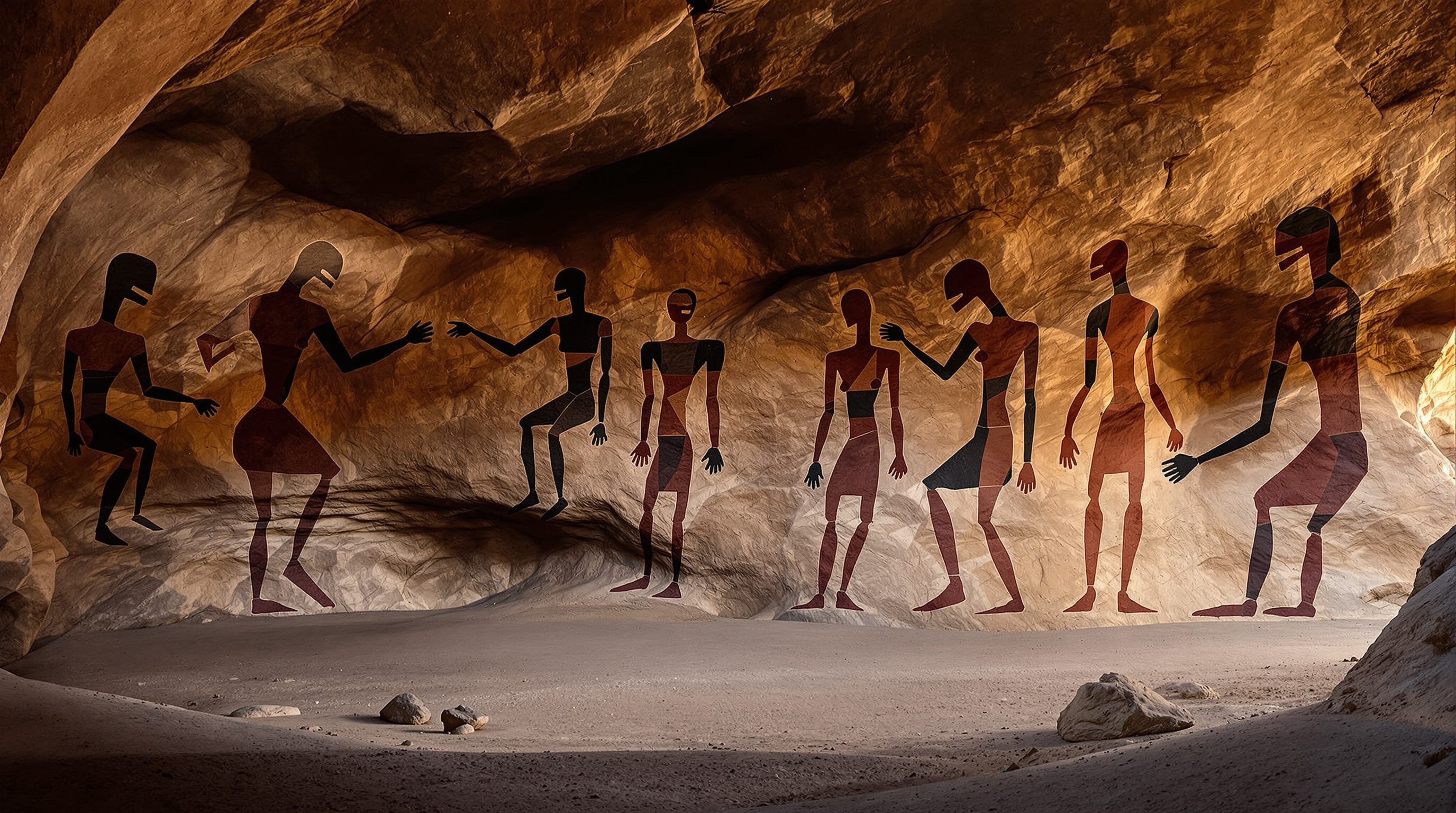
The North American rock art record is vast and varied, spanning tens of thousands of years and encompassing dozens of distinct regional traditions. From the great painted murals of the American Southwest to the engraved outcrops of the Great Lakes region, from the carved boulders of Appalachia to the painted caves of the Pacific coast, North America's prehistoric imagery reflects the creative traditions of hundreds of distinct cultural groups across deep time.
The American Southwest
The Colorado Plateau, the Great Basin, and adjacent areas harbor a remarkable concentration of sites representing traditions spanning from the Archaic period (c. 7000 BCE–1 CE) through the historic period of the 19th century.
The Barrier Canyon Style — named for Barrier Canyon (now Horseshoe Canyon) in southeastern Utah — is among the oldest and most visually distinctive prehistoric art traditions in North America. Characteristic Barrier Canyon figures are large, elongated, broad-shouldered anthropomorphs painted in dark red or maroon, often lacking arms and legs, sometimes accompanied by smaller satellite figures, snakes, and abstract elements. The figures convey a haunting, otherworldly presence that has led most researchers to interpret them in a ritual or shamanic context. Horseshoe Canyon, Canyonlands NPS.
Other major Southwestern traditions include Ancestral Puebloan rock art of the Four Corners region, the Fremont tradition of Utah and Colorado, and historic-period imagery of the Navajo and other peoples. The Petroglyph National Monument in Albuquerque protects more than 20,000 images. Petroglyph National Monument.
The Eastern Woodlands
East of the Mississippi, rock art sites are less numerous but often exceptionally informative. The Appalachian and Piedmont regions of Virginia, West Virginia, Georgia, and the Carolinas contain pecked petroglyphs associated with Woodland and Mississippian-period cultures. Sites in Ohio and Illinois include rock art connected to the Hopewell and related traditions. These eastern sites have received less scholarly attention than their Southwestern counterparts, but they are important records of the artistic and cosmological traditions of Eastern Woodlands peoples.
The Great Lakes and Northern Plains
The Great Lakes region — including Wisconsin and Minnesota — contains significant concentrations of rock art, predominantly petroglyphs pecked into Canadian Shield granite outcrops. Many sites are associated with Ojibwe and other Algonquian-speaking peoples. The Northern Plains and Rocky Mountain areas — including South Dakota and Wyoming — contain both petroglyphs and pictographs associated with historic-period Plains cultures as well as much older Archaic traditions.
The Columbia Plateau
The Columbia Plateau, encompassing much of Washington, Oregon, and Idaho, is home to a remarkable rock art tradition centered on the Columbia River and its tributaries. Elaborate polychrome pictographs and densely packed petroglyph panels characterize the tradition. Flooding from Bonneville Dam inundated several major sites in the 1930s, but significant concentrations survive at Columbia Hills State Park in Washington.
The Great Basin and California
The Great Basin — the internally drained expanse covering Nevada and adjoining parts of Utah, Oregon, and California — holds some of the oldest securely dated rock art on the continent. Deeply repatinated abstract petroglyphs near Winnemucca Lake in western Nevada have been bracketed by their carbonate coatings to a period when the lake stood at levels not seen for many thousands of years. Further south, the polychrome panels of the Coso Range and the Chumash sites of south-central California present a different visual world: densely superimposed, brilliantly coloured, and tied in the ethnographic record to ceremonial practice. The contrast — austere abstraction in the north, saturated figuration on the coast — is a reminder that "North American rock art" is a geographic convenience, not a single tradition.